Students Showcase Over 20 Physics Models at Jawaharlal Nehru Planetarium
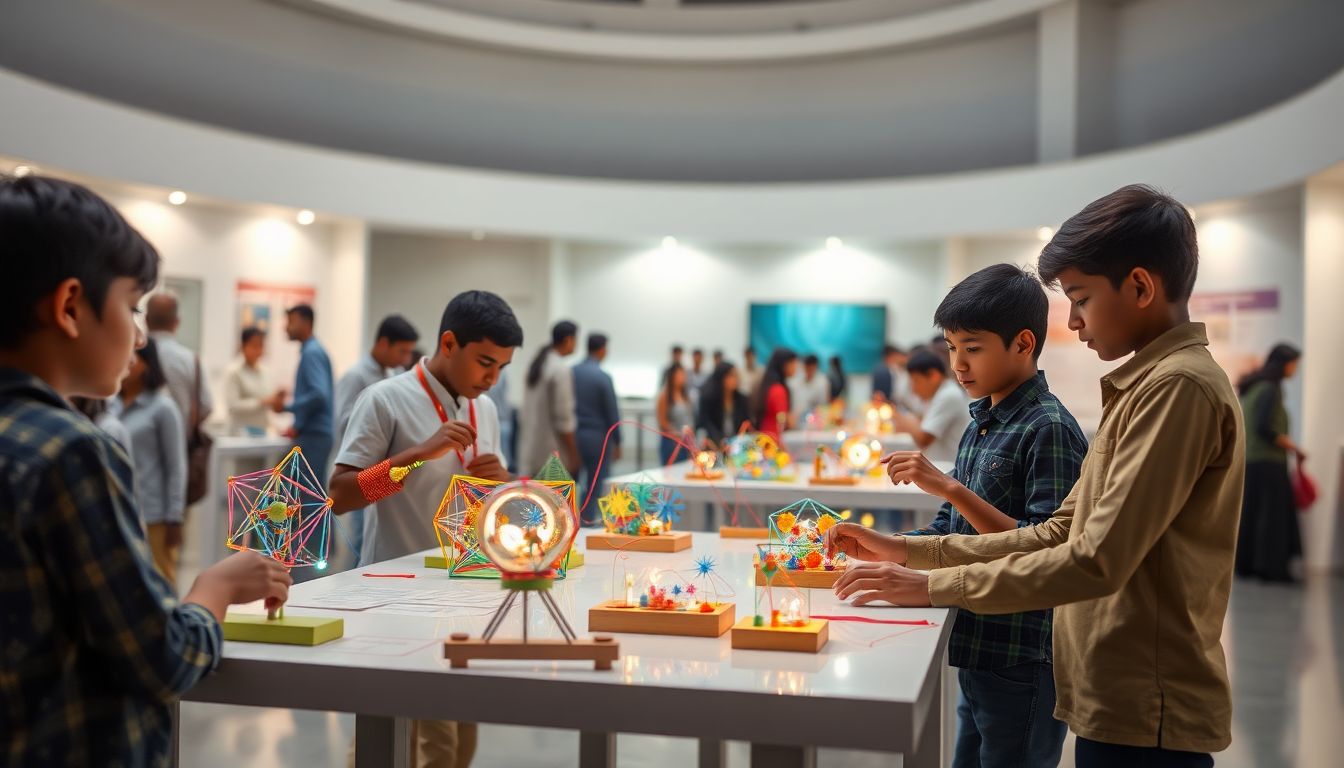
Student volunteers in Bengaluru showcased fundamental laws of physics using everyday items such as sticky tape, discarded plastic bottles, and ping-pong balls at the three-day ‘Science in Action’ exhibition held at the Jawaharlal Nehru Planetarium. The event, which concludes on August 30, featured more than 20 dynamic working models designed to bring textbook theories into practical reality.
Among the key highlights at the planetarium was an optical experiment titled ‘Birefringence of Cello Tape’, created and presented by Grade 9 students Advika Sree Gowda, Navaketan Krishal Y, and Manish Chandra L from Rays Academy For Learning.
The team applied layered patterns of clear tape onto glass sheets placed between two crossed polarisers. When white light was directed through the arrangement, the rays split into two varying refractive indices. The resulting optical interference created bursts of colour, visually demonstrating how light polarisation alters depending on the thickness of the material.
Acoustics and air pressure were highlighted in an exhibit called ‘Singing Bottles – Tune with Pressure’, presented by Nisarga Vidyanikethana School Grade 9 students Ganavi B, Vaishnavi, and Ganavi S. The trio fitted identical plastic bottles with bicycle valves and inflated each container with varying amounts of air using a bicycle pump.
By tapping the bottles, the students produced distinct musical notes. Their demonstration proved that increased internal air pressure creates a stiffer air cushion inside the bottle, accelerating the natural vibrational frequency and generating sharper, higher-pitched tones.
In another demonstration, Rithvika, Lasika S, and Aiman B, Grade 9 and 10 students from Parampara Public High School, presented ‘Balancing the Ball’ to explain equilibrium and stability.
Using a simple apparatus made of a ping-pong ball, tape, and downward-facing weights fixed to a vertical rod, the students illustrated how extending mass downward moves the overall centre of gravity below the contact point. This mechanism enabled the unstable ping-pong ball to remain balanced atop a narrow tip throughout the demonstration.