Prey Decline and Habitat Degradation Threaten Tigers in Bhadra and Kali Reserves
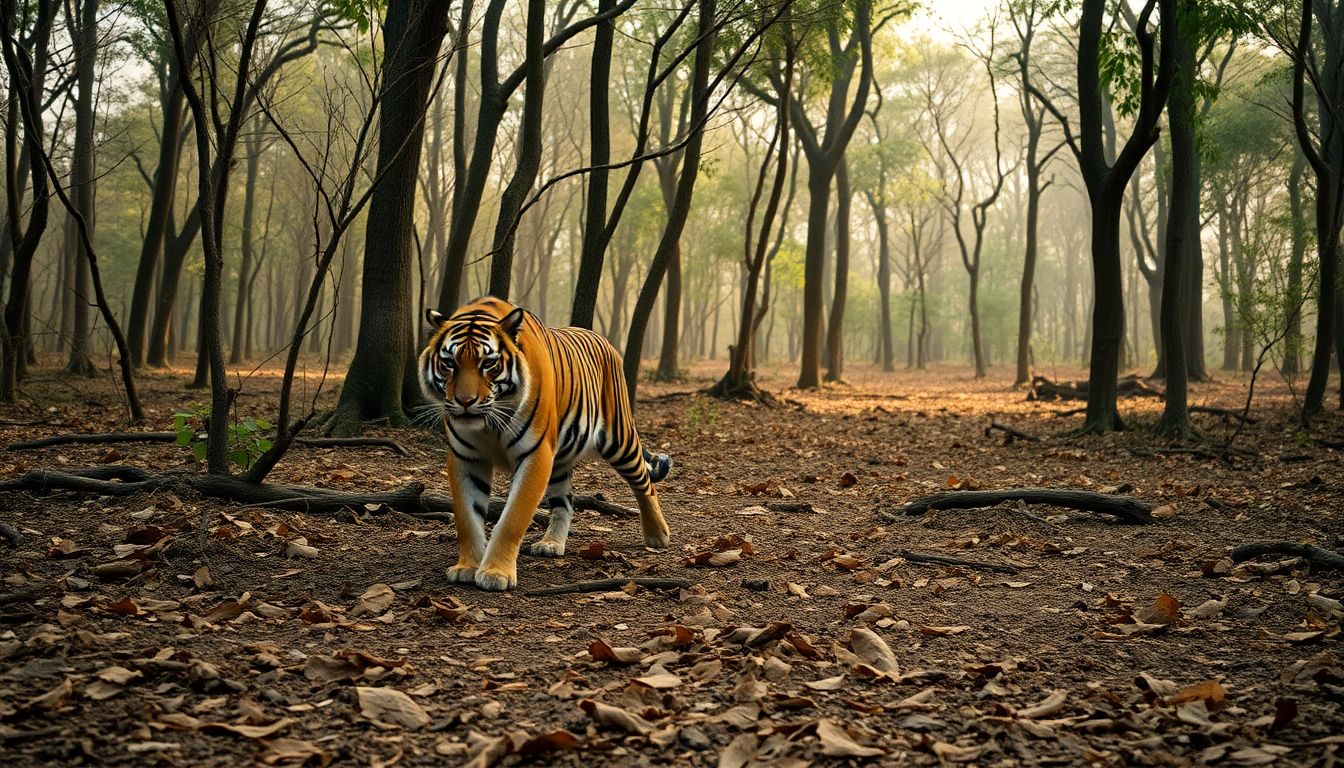
A recent report by the Union Ministry of Environment, Forest and Climate Change has warned that a decline in prey density and deteriorating habitat quality are threatening tiger populations in Karnataka’s Bhadra and Kali tiger reserves. The findings have raised significant concerns over the long-term conservation of wild tigers in these protected areas.
According to the report, the tiger density in the Kali Tiger Reserve has dropped to 0.57 tigers per 100 square kilometers. This low density is directly linked to a scarcity of preferred prey. The density of chital has fallen to 0.0149 per square kilometer, while sambar density stands at just 0.0357 per square kilometer.
The Karnataka Forest Department stated that both Bhadra and Kali continue to support relatively low tiger populations primarily due to this low prey density rather than habitat loss alone. The report also identified other limiting factors, including high biotic pressure, fragmented connectivity, highly undulating terrain, and the lack of a source population in the adjoining landscape.
Kumar Pushkar, Principal Chief Conservator of Forests and Chief Wildlife Warden of Karnataka, explained that both reserves receive high rainfall and are dominated by dense evergreen forests of the Western Ghats. He noted that such ecosystems naturally support lower densities of large mammals compared to dry and moist deciduous forests.
Pushkar also pointed out that Bhadra underwent a voluntary village relocation program in 2004–05 to improve habitat quality. He added that the replenishment of wild prey is a gradual process, and the department expects long-term benefits to show in upcoming tiger estimation cycles.
To address the imbalances, the National Tiger Conservation Authority is closely monitoring the situation. While a successful tiger reintroduction program modeled after the Sariska and Panna reserves is being piloted in five other reserves across India, officials indicated it could eventually be adopted in Bhadra and Kali if successful.
In contrast, other Karnataka reserves are performing well. The Bandipur Tiger Reserve supports 150 tigers with a density of 9.50 per 100 square kilometers and a healthy prey base of 25.91 chital per square kilometer. Meanwhile, the Nagarhole Tiger Reserve hosts 141 tigers with a density of 11.15 per 100 square kilometers.