Over 100 Writers Petition DK Shivakumar Seeking Resolution Against NEET
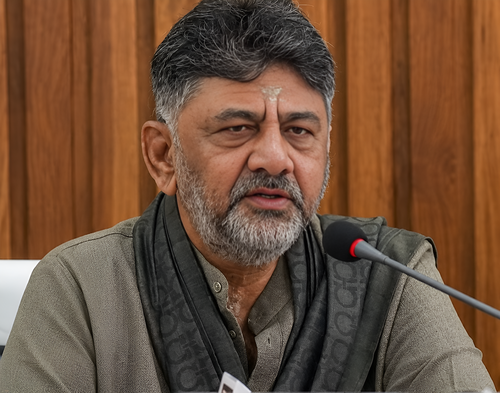
More than 100 writers and progressive thinkers in Bengaluru have submitted a petition to Chief Minister D.K. Shivakumar, urging the state legislature to pass a resolution against the National Eligibility-cum-Entrance Test (NEET) and the National Testing Agency (NTA). The petition comes ahead of the legislature's Monsoon Session, which is set to begin on Thursday.
Prominent signatories of the petition include retired Supreme Court judge Justice Gopal Gowda, former Vice-Chancellor Sabiha Bhoomigowda, writer Mudnakudu Chinnaswamy, and educationist Niranjanaradhya, along with other representatives of civil society.
In their submission, the petitioners stated that compulsory NEET implementation across the country for medical admissions severely undermines the federal principles of the Constitution, state educational autonomy, social justice, and equal opportunity.
The civil society representatives unanimously urged the state government to pass a resolution during the upcoming Karnataka Legislative Session pressing the Union Government to cancel NEET and the NTA, and to return the medical admission process and policy directly to the states.
The signatories pointed out that while education is a subject where both the Centre and the States hold legislative powers, Section 14 of the National Medical Commission Act, 2019, has reduced the authority of states in selecting medical students. They argued that imposing a single uniform test fails to achieve real equality in a country with diverse curricula, languages, socio-economic variations, and rural-urban inequalities.
Additionally, the petition highlighted that NEET has diminished the role of school education by compressing two years of continuous student learning into a single-day multiple-choice test.
The petitioners argued that the exam structure predominantly benefits students from urban areas and wealthier families who can afford private coaching. In contrast, it creates unequal competition for students from government schools, rural areas, Kannada-medium backgrounds, and socio-economically disadvantaged communities.